

What if the "pub rules" you’ve spent years defending are actually the only things stopping you from clearing the table? We’ve all been there, stuck in a heated debate over whether a scratch means "behind the line" or "ball-in-hand" while the social energy of the night grinds to a halt. It's frustrating when conflicting house rules turn a friendly game into a confusing standoff. Mastering the 8 ball pool rules for beginners is the fastest way to transition from a casual player to a respected competitor at any venue in the Inner West or Strathfield.
This guide will cut through the noise and give you the clarity needed to step up to a professional Diamond table at Club9 in North Strathfield with total confidence. You'll learn how to execute a legal break, identify common fouls, and master the etiquette required to dominate the felt across Sydney. We’re going to walk through everything from the opening lag to the final black ball, so you can stop arguing and start winning.
Key Takeaways
- Master the "call-shot" system and learn the precise way to rack the balls with the 8-ball at the center and the apex ball on the foot spot.
- Navigate the transition from a casual player to a competitor by understanding the essential 8 ball pool rules for beginners, including how to manage an "open table" after the break.
- Enhance your precision and avoid embarrassing fouls by learning when to use strategic "safety plays" and why chalking your cue is a non-negotiable habit.
- Elevate your game in a professional environment by practicing on tournament-grade Diamond and Rasson tables at Club9 in North Strathfield.
Understanding the Basics of 8 Ball Pool
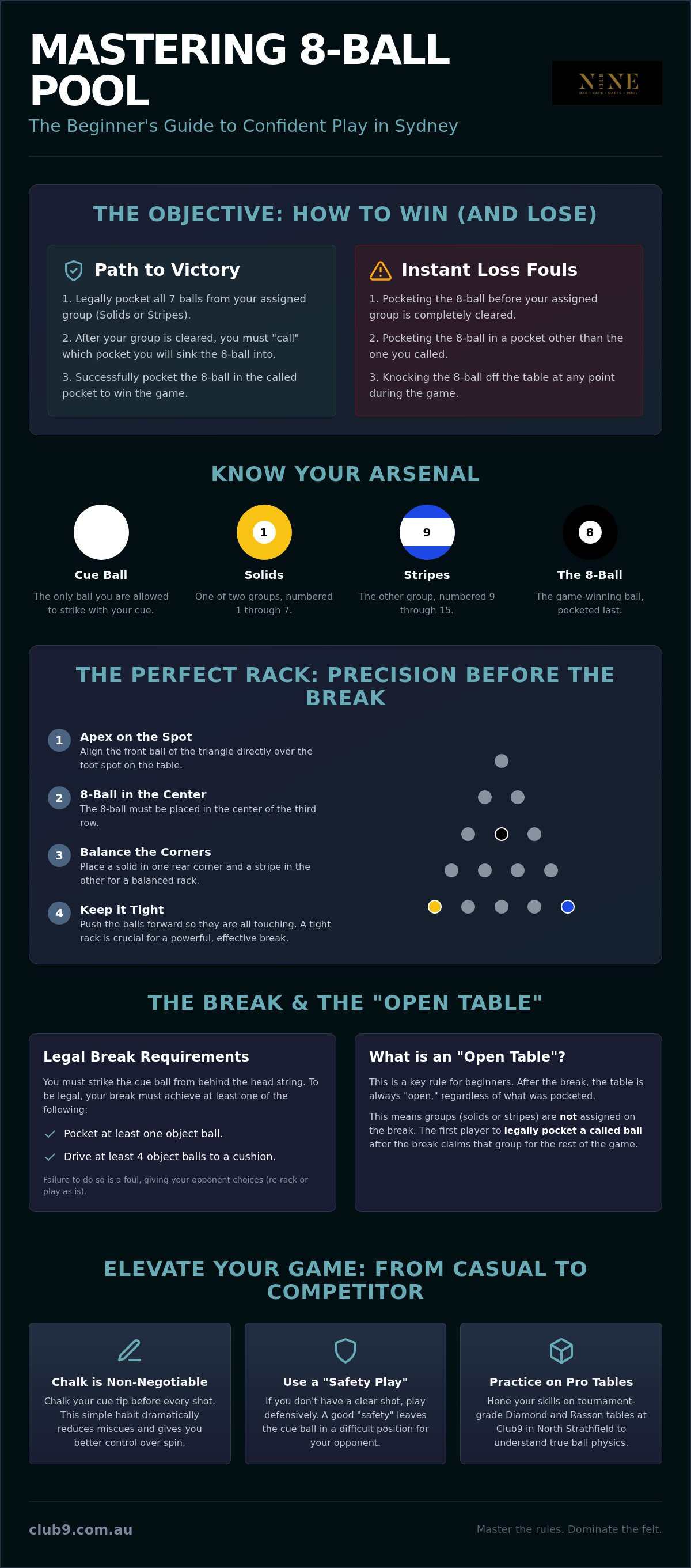
8 ball pool isn't just a casual pub pastime; it's a game of calculated strategy and refined skill that rewards precision over luck. At its core, the game is a "call-shot" discipline played with 15 object balls and a single cue ball. This means you don't simply hit and hope. Instead, you must clearly indicate which ball you intend to pocket and which hole it will enter before you take your stroke. Standardizing your approach with the official rules of 8-ball transforms a standard social night in the Inner West into a high-stakes competitive experience.
The 15 object balls are divided into two distinct groups that dictate your path to victory. Balls numbered 1 through 7 are known as "Solids," easily identified by their vibrant, single-color finish. Balls 9 through 15 are "Stripes," which feature a distinctive white band across the center. The black 8 ball remains the centerpiece of the game, serving as the ultimate game-winner that must stay on the table until the very end. To execute a legal shot, you must strike a ball from your assigned group first and ensure that either a ball is pocketed or at least one ball on the table contacts a cushion after the hit.
The Objective: How to Win the Game
Winning requires more than just potting balls at random. You must successfully pocket every ball in your assigned group—either all solids or all stripes—before you earn the right to shoot for the 8 ball. The final black ball must be potted into a designated pocket that you call before the shot begins. Accuracy is paramount here because the margin for error is zero. If you pocket the 8 ball before clearing your entire group, or if you sink it in a pocket other than the one you called, you lose the frame instantly. This high-pressure finish is exactly what draws serious players to the tables in Strathfield.
Essential Equipment for Beginners
Your primary tool is the cue ball, the solid white ball that acts as your messenger on the felt. You don't aim for the cue ball itself; you aim through it to connect with your target. Using a straight, well-maintained house cue is vital for consistency, as even a slight warp can ruin a perfect line of sight. At premium venues in North Strathfield like Club9, the equipment is meticulously maintained to ensure your bridge and stroke remain fluid. High-quality tables, such as Diamond or Rasson models, provide a predictable roll and true bounces, which is essential when learning 8 ball pool rules for beginners. Investing time on professional-grade cloth helps you understand how speed and spin affect the game, something you won't find on a neglected local pub table.
Setting Up the Table and the Opening Break
A professional game begins long before the first strike. Precision in the setup is what separates a high-end match in North Strathfield from a messy pub scuffle. To start, you must position the apex ball of the triangle directly over the foot spot. This ensures the balls are centered and ready for maximum dispersion. When learning 8 ball pool rules for beginners, the rack's composition is your first lesson in etiquette. The 8 ball must sit in the very center of the triangle, specifically in the middle of the third row. To maintain balance, place a solid ball in one bottom corner and a stripe in the other. The remaining balls can be placed at random, but the pack must be tight. A loose rack absorbs the energy of your break, resulting in a "dead" spread that kills the momentum of the game.
The Proper Way to Rack the Balls
Consistency is the hallmark of a disciplined player. Follow these steps to ensure every frame starts with professional standards:
- Step 1: Align the triangle so the front ball sits exactly on the foot spot.
- Step 2: Place the black 8 ball in the center of the third row, surrounded by other object balls.
- Step 3: Ensure you have a solid in one rear corner and a stripe in the other to prevent an unfair advantage.
- Step 4: Use your fingers to push the balls forward within the rack, ensuring they are all touching. A gap-free rack is essential for a "live" break.
Mastering the Break Shot
The break is your chance to exert dominance over the table. You must strike the cue ball from "baulk," which is the area behind the head string. For a break to be considered legal under standard rules, you must either pocket an object ball or ensure at least four object balls hit a cushion. If you fail to do this, your opponent can demand a re-rack or take the table as it lies. If you're looking to sharpen your technique, you can hire a professional 7ft or 9ft table at our North Strathfield venue to practice your power and accuracy.
One of the most common points of confusion for beginners is the "Open Table" rule. Potting a ball on the break does not mean you have chosen your group. The table remains open until a player legally pockets a "called" ball after the break. This means even if you sink three stripes on the opening shot, you can still choose to play solids if the layout is more favorable. However, if you pocket the cue ball on the break, it's a scratch. In competitive play, this typically results in your opponent receiving ball-in-hand behind the head string, though professional variations often allow ball-in-hand anywhere on the felt. Mastering these opening 8 ball pool rules for beginners ensures you start every match with the confidence of a seasoned pro across the Inner West.
Choosing Your Group and Executing Legal Shots
The transition from the opening break to the middle game is where most social players get tripped up by "pub rules." In a professional setting, the table remains "open" immediately after the break, regardless of what balls were pocketed. This means your group (solids or stripes) isn't determined by luck. You must legally pot a "called" ball to claim your group. To avoid fluke wins and keep the game sophisticated, you must "call your pocket." This simply means you indicate which ball is going into which hole before you strike. If the ball goes in a different pocket, your turn ends, but the table remains open for your opponent.
Executing a legal shot requires more than just making contact. You must hit a ball from your assigned group first. Once the cue ball strikes your target, the "Rail Rule" comes into play. This rule dictates that at least one ball on the table must either be pocketed or touch a cushion (rail) after the initial contact. If you hit your ball but nothing touches a rail or falls into a pocket, it's a foul. This prevents players from simply rolling the ball a few inches to "snooker" their opponent without actually attempting a shot. Mastering these 8 ball pool rules for beginners will immediately elevate your status at any premium venue in Sydney.
Solids vs. Stripes: How Groups are Determined
The moment the table is no longer "open" occurs only after a player legally pockets a called ball from their chosen group. Strategy plays a massive role here. If you're playing on a professional Rasson table in North Strathfield, take a second to survey the spread. You might choose a group with more difficult shots if the balls are better positioned for a "run-out." If you happen to pot one ball from each group on the same called shot while the table is open, you still get to choose your group, but you must declare it clearly. This level of tactical thinking is what separates the Inner West’s casual players from the true competitors.
Common Fouls and "Ball-in-Hand" Explained
Fouls are the most common source of arguments in casual games, usually because of confusion over the "ball-in-hand" rule. In competitive 8 ball pool rules for beginners, a foul gives your opponent the ultimate advantage: the ability to place the cue ball anywhere on the felt. This is a significant upgrade from the restrictive "behind the line" rule found in many local pubs. You give up ball-in-hand if you:
- Scratch: Pocket the cue ball or knock it off the table.
- Hit the wrong group: Fail to strike one of your own balls first.
- Commit a rail foul: Fail to drive a ball to a cushion after contact.
Winning a frame often comes down to how you use these opportunities. When you have ball-in-hand at a high-end venue in Strathfield, don't rush. Use the advantage to clear your most difficult "problem balls" and take control of the table.
Beginner Strategies and Table Etiquette
Mastering the mechanics is only half the battle. To truly dominate the felt in the Inner West, you must embrace the strategic depth that defines a seasoned player. Many people learning 8 ball pool rules for beginners focus exclusively on potting balls, but the most sophisticated competitors know when to play defensively. This is known as a "Safety Play." If you don't have a clear shot, your best move is often to strike your ball and leave the cue ball in a position that makes your opponent's next turn nearly impossible. It’s a game of geometry where controlling the table is just as vital as sinking the 8 ball.
Success also depends on your preparation before the bridge is even set. Chalk your cue before every single shot. This simple habit increases friction between the tip and the cue ball, preventing the dreaded "miscue" that can hand your opponent an easy victory. While you’re focused on your game, remember that table maintenance is a sign of respect for the sport. Keep all drinks on the designated stands and off the felt. At a premium venue like Club9 in North Strathfield, the cloth is a precision instrument, and even a small spill can ruin the predictable ball travel we’ve discussed in previous sections.
Defensive Play: When Not to Pot a Ball
Sometimes, the smartest shot is the one that doesn't end in a pocket. If a ball is "snookered," it means there is no direct path to it. You can intentionally leave your opponent in this tough spot to force a foul. While intentional fouls are often debated in casual pub settings, they are a legitimate part of competitive strategy in Sydney. Just ensure you still satisfy the rail rule by hitting your own ball and driving something to a cushion. If you want to test these tactics with your team, our corporate event packages offer the perfect environment to learn and compete together.
Pool Hall Etiquette for Social Players
Respecting the social energy of the room is essential for any player in Strathfield. Always wait for your turn away from the table and out of your opponent's line of sight. Hovering over a player while they aim is a major breach of etiquette. Additionally, most professional venues prohibit jump shots. These shots often damage the high-quality cloth on Diamond or Rasson tables. When your session ends, return your house cues to the rack neatly. This keeps the space organized and ready for the next group of enthusiasts entering the inner circle of the Sydney pool scene.
Elevating Your Game at Club9 North Strathfield
Theory is essential, but applying what you've learned on the right equipment is what builds lasting muscle memory. Club9 in North Strathfield serves as the premier destination to put your new skills to the test. With 34 professional-grade tables available, you'll find a massive space dedicated to the intersection of athletics and aesthetics. This isn't your average local establishment; it's a high-end hub designed for those who take their social sports seriously. Transitioning from basic 8 ball pool rules for beginners to confident table play happens faster when you're surrounded by an environment that respects the game.
Why Professional Tables Make a Difference
Consistency is the enemy of the amateur, and professional equipment is the solution. Standard pub tables across Sydney often suffer from uneven slate or worn-out cushions, making it impossible to predict ball travel. Playing on Diamond pool tables in Sydney changes the dynamic entirely. These tables are engineered for tournament-level precision, ensuring that every bank shot and safety play follows the laws of physics exactly as intended. We also provide Rasson 7ft and 9ft tables to suit different skill levels. The professional cloth and cushions used at our North Strathfield venue allow beginners to see the immediate results of a well-executed stroke, reinforcing the rules through predictable, high-quality feedback.
Corporate Events and Social Play in the Inner West
The Inner West has a vibrant social scene, and mastering the rules allows you to lead the pack during your next group outing. If you're searching for a corporate team building venue in Sydney, bringing your colleagues to a refined space like Club9 is a smart strategic move. Learning 8 ball pool rules for beginners as a team fosters healthy competition and clear communication. You can pair your practice sessions with our signature cocktails and gourmet burgers, ensuring the social energy remains high throughout the night. Whether you're joining our social leagues to test your knowledge or booking a private table for a refined evening in North Strathfield, you'll find that playing by the book is the fastest way to join the inner circle of the Sydney pool community.
Step Up to the Table with Confidence
Standardizing your game is the first step toward becoming a true competitor. You’ve moved beyond the confusion of house rules and learned how to execute a legal break, manage an open table, and use safety plays to your advantage. These 8 ball pool rules for beginners provide the foundation you need to handle any frame with professional poise. It’s time to take that knowledge from the screen to the felt and show your opponents what a disciplined game looks like.
Club9 is the Inner West’s premier destination for cue sports, offering an unmatched atmosphere in North Strathfield. With 34 world-class Diamond and Rasson tables, you have the perfect space to practice your precision while enjoying a full licensed bar and gourmet kitchen. Whether you’re planning a social night or looking to join a league, our facility provides the high-end equipment your game deserves. It's the ultimate venue to refine your skills in a space that values both competition and community.
Book a Professional Table at Club9 North Strathfield and dominate the table today. We’ll see you at the break.
Frequently Asked Questions
What happens if I pot the 8 ball on the break?
Potting the 8 ball on the break is not an automatic win or loss under professional standards. You typically have the choice to either re-rack the balls and break again or spot the 8 ball and continue your turn. This rule prevents a frame from ending on pure luck, ensuring the match remains a true test of skill from the opening strike in North Strathfield.
Do I have to hit a cushion on every shot in 8 ball pool?
You must ensure that at least one ball touches a cushion or is pocketed after the cue ball makes contact with your target ball. This is a fundamental part of 8 ball pool rules for beginners known as the "Rail Rule." It stops players from simply rolling the ball a few inches to snooker an opponent without making a legitimate attempt at a shot.
Is it a foul if I hit my opponent’s ball after hitting mine?
It is completely legal to strike your opponent’s ball as long as the cue ball contacts your own group first. Once you have made legal primary contact, any subsequent collisions are valid parts of the play. Skilled players in the Inner West often use this tactic to break up clusters or move an opponent's ball into a less favorable position on the felt.
What does "ball-in-hand" mean and how do I use it?
Ball-in-hand is a strategic advantage awarded to you after your opponent commits a foul, allowing you to place the cue ball anywhere on the table. You aren't restricted to the area behind the head string. Use this opportunity to clear your most difficult balls or set up a perfect run-out. It is the ultimate tool for turning a defensive situation into an offensive victory.
Can I win the game if I pot the 8 ball and the cue ball at the same time?
Pocketing the 8 ball and the cue ball on the same shot results in an immediate loss of the game. The final shot requires absolute precision because a scratch at this stage is fatal to your score. If the black ball drops but the white ball follows it into a pocket, the frame ends instantly and your opponent is declared the winner.
How do I know where to find the best 8 ball pool near me in Sydney?
The premier destination for cue sports in Sydney is Club9, located in the historic Bakehouse Quarter in North Strathfield. With 34 professional Diamond and Rasson tables, it offers a high-end experience that far exceeds a standard local pub. It is the most sophisticated space in the Inner West to practice the rules you have learned in a refined, social environment.
What is the difference between solids and stripes in pool?
Solids and stripes are the two groups of object balls that determine your targets for the duration of the game. Solids are numbered 1 through 7 and feature a single, solid color. Stripes are numbered 9 through 15 and are identified by a distinctive white band. These visual markers help you track your progress as you work toward the final 8 ball in Strathfield.
Is it okay to use jump shots in a pool hall?
Most professional venues strictly prohibit jump shots because they can easily damage the high-quality cloth on the tables. Striking the cue ball at a steep downward angle often causes tears or burns on the felt. When playing at premium locations in North Strathfield, stick to bank shots or kick shots to navigate around obstacles and show respect for the equipment.


